Emergency Hail Storm Damage? We guarantee a 2-hour on-site inspection! Click to Call.
2026 Commercial Roofing Guide
Commercial Roof Types in Oklahoma
Managing a commercial property in OKC? This guide covers every major flat and low-slope roofing system
Guides
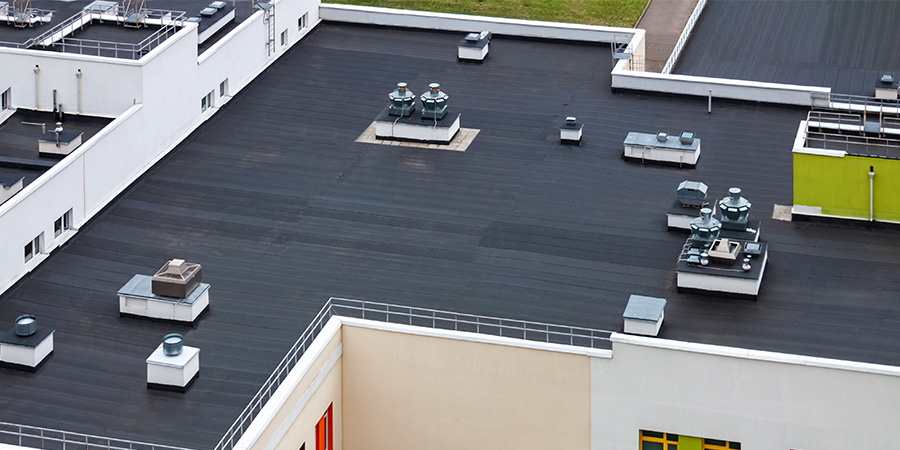
Flat Roofs vs Low-Slope Roofs: What's the Difference?
In Oklahoma, proper drainage design is non-negotiable regardless of slope. Our heavy spring rains (3–5 inches in a single storm) overwhelm inadequate drain systems fast.
Almost all commercial roofs fall into two categories, and the distinction matters for material selection:
Flat Roof (0–¼:12 slope)
Truly flat or near-flat. Requires membrane systems (TPO, EPDM, PVC) or built-up roofing with proper drainage. Ponding water is the #1 concern, proper drainage design is critical.
Low-Slope (¼:12–3:12)
Slight pitch, enough to shed water but not steep enough for traditional shingles. Can use membrane systems, modified bitumen, or standing seam metal.
The Oklahoma Commercial Roof Stress Test
Oklahoma’s climate is uniquely punishing for commercial roofs. Large flat surfaces collect hail, absorb extreme heat, and pool water in ways residential pitched roofs don’t. Understanding different commercial roof types can help property owners choose the right system for long-term durability and performance. Here’s how each system performs. Learn more about us!
70+ MPH Straight-Line Winds
BEST
Standing Seam Metal, PVC (heat-welded)
GOOD
TPO (heat-welded), Modified Bitumen
RISK
EPDM (glued seams), loose-laid systems
Golf-Ball Sized Hail (1.75″+)
BEST
Standing Seam Metal, 60-mil PVC
GOOD
60-mil TPO, Modified Bitumen
RISK
45-mil single-ply, aged EPDM
105°F+ Summer Heat
BEST
White TPO, White PVC, Cool-coat Metal
GOOD
White EPDM, Reflective coatings
RISK
Black EPDM, dark surfaces
Ponding Water (48+ hrs)
BEST
PVC (chemical-resistant), Spray Foam (tapered)
GOOD
TPO, Modified Bitumen with drainage
RISK
EPDM (glue fails), Mod Bit without drainage
Commercial Roofing Materials Deep Dive
For each system, at MT Roofing OKC, we cover what it is, its lifespan, cost tier, pros, cons, and Oklahoma-specific recommendations.
Most Popular
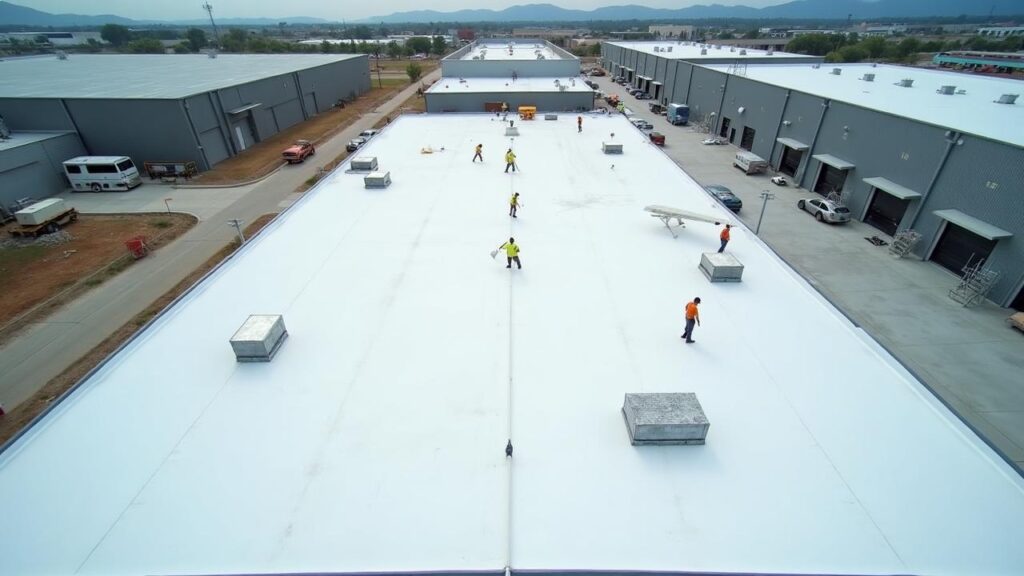
TPO has become the dominant commercial roofing material in Oklahoma thanks to its energy efficiency, weldable seams, and competitive pricing. White TPO reflects up to 80% of solar heat, critical for reducing cooling costs in Oklahoma’s brutal summers.
Lifespan
15–25 years
Cost
$$
Maintenance
Low
Storm Performance
Very Good (heat-welded seams resist wind uplift)
Energy Efficiency
Excellent (reflects 80%+ solar heat, ENERGY STAR rated)
Pros
- Chemical and UV resistant
- Most cost-effective single-ply membrane
- ENERGY STAR rated, significant cooling savings
- Lightweight, no structural reinforcement needed
- Heat-welded seams are stronger than the membrane itself
Cons
- Shorter track record than EPDM or BUR
- Quality varies significantly between manufacturers
- Can be punctured by foot traffic or debris
- Seam integrity depends on installer skill
What we recommend
TPO is our #1 recommendation for Oklahoma commercial buildings. The energy savings alone, often $0.30–$0.50 per square foot annually, make it the smartest choice for our 100°F+ summers. We install 60-mil minimum for all commercial projects.
179D Tax Strategy
In 2026, TPO isn’t just a roof, it’s a tax strategy. Its high reflectivity is the fastest path to meeting 179D energy standards, potentially qualifying for deductions up to $5.94/sq ft before the June 30 deadline.
TPO come in three types:
Standard TPO (45 mil)
Entry-level thickness. Suitable for smaller commercial buildings. 10–15 year warranty typical.
Premium TPO (60 mil)
Industry-preferred thickness. Better puncture resistance, longer warranty (15–20 years). Best for high-traffic roofs.
Heavy-Duty TPO (80 mil)
Maximum durability. Ideal for large facilities with rooftop equipment. 20–25 year warranty.
Proven Track Record
EPDM has been the commercial roofing workhorse since the 1960s. This black (or white) rubber membrane is known for its exceptional durability, flexibility in temperature extremes, and simple repair process.
Lifespan
20–30+ years
Cost
$$
Maintenance
Low
Storm Performance
Very Good (exceptional flexibility prevents cracking in freeze-thaw cycles)
Energy Efficiency
Moderate (black) / Good (white reflective)
Pros
- Simple, inexpensive repairs
- Resists UV, ozone, and weathering
- Available in large sheets to minimize seams
- Longest track record of any single-ply membrane
- Excellent flexibility in extreme temperatures (-40°F to 300°F)
Cons
- Not as puncture-resistant as PVC
- Can shrink over time, pulling at flashings
- Black EPDM absorbs heat — increases cooling costs
- Seams are glued, not welded (weaker than TPO seams)
What we recommend
EPDM is a solid choice for Oklahoma commercial buildings, especially when budget is the primary concern. For new installations, we recommend white EPDM to combat our summer heat. For existing black EPDM roofs, a reflective coating can extend life 10–15 years.
EPDM come in three types:
45-mil EPDM
Standard thickness for most commercial applications. Adhered or mechanically attached.
60-mil EPDM
Premium thickness with superior puncture and tear resistance. Recommended for high-traffic areas.
White EPDM
Reflective version for energy efficiency. Gaining popularity in Oklahoma’s hot climate.
Best Chemical Resistance
PVC roofing is the premium single-ply option, offering superior chemical resistance and the strongest heat-welded seams in the industry. It’s the go-to choice for restaurants, hospitals, and facilities with rooftop grease or chemical exposure.
Lifespan
20–30+ years
Cost
$$
Maintenance
Very Low
Storm Performance
Excellent (heat-welded seams, superior wind uplift resistance)
Energy Efficiency
Excellent (white reflective surface, ENERGY STAR rated)
Pros
- Strongest seams in the single-ply category (heat-welded)
- Superior chemical and grease resistance
- Excellent fire resistance (self-extinguishing)
- Highly reflective — top energy performer
- Resists mold, bacteria, and root penetration
Cons
- Most expensive single-ply option
- Less flexible than EPDM in extreme cold
- Fewer manufacturer options than TPO
- Can become brittle with age in some formulations
What we recommend
PVC is our recommendation for Oklahoma restaurants, medical facilities, and any building with rooftop grease exhaust. The chemical resistance is unmatched. For standard office and retail, TPO delivers similar performance at a lower price point.
179D Tax Strategy:
PVC’s superior reflectivity and energy performance make it a strong 179D candidate. For restaurants and medical facilities, PVC delivers both chemical resistance and tax deduction eligibility.
PVC come in 2 types:
Standard PVC (50 mil)
Entry-level commercial grade. 15–20 year warranty. Good for most applications.
Premium PVC (60–80 mil)
Enhanced thickness with superior puncture resistance. 20–25 year warranty. Ideal for high-traffic roofs.
Best for Repairs & Overlays
Modified bitumen is a modern evolution of the traditional built-up roof (BUR). It uses asphalt-based rolled sheets modified with rubber (SBS) or plastic (APP) polymers for enhanced performance. It’s especially popular for reroofing over existing flat roofs.
Lifespan
15–25 years
Cost
$–$$
Maintenance
Moderate
Storm Performance
Good (multi-layer redundancy, good puncture resistance)
Energy Efficiency
Moderate (granule-surfaced caps available in reflective white)
Pros
- Can be patched and repaired easily
- Excellent for reroofing over existing flat roofs
- Familiar technology — wide installer availability
- Good foot-traffic resistance with granule surface
- Multi-layer redundancy — built-in backup waterproofing
Cons
- Heavier than single-ply membranes
- Not as energy-efficient as TPO or PVC
- Multiple layers increase installation time and cost
- Torch-applied options require open flame (fire risk during install)
What we recommend
Modified bitumen is our go-to for Oklahoma commercial reroofing projects — especially when tearing off the existing roof isn’t practical or cost-effective. SBS mod bit handles our freeze-thaw cycles better than APP. For new construction, TPO or PVC typically makes more sense.
Modified Bitumen come in three types:
SBS Modified (Styrene-Butadiene-Styrene)
Rubber-modified. Excellent flexibility and cold-weather performance. Torch-applied or self-adhering.
APP Modified (Atactic Polypropylene)
Plastic-modified. Superior UV and heat resistance. Typically torch-applied.
APP Modified (Atactic Polypropylene)
Plastic-modified. Superior UV and heat resistance. Typically torch-applied.
Best Longevity
Standing seam metal isn’t just for residential. Commercial standing seam systems provide the longest lifespan of any commercial roofing material, with superior wind and hail resistance. They’re ideal for churches, retail centers, and any commercial building where aesthetics and longevity matter.
Lifespan
Excellent (140+ mph wind ratings, superior hail resistance)
Cost
$$$–$$$$
Very Low
Moderate
Storm Performance
Excellent (140+ mph wind ratings, superior hail resistance)
Energy Efficiency
Excellent (cool-coated options reflect 70%+ solar heat)
Pros
- Virtually maintenance-free
- 100% recyclable at end of life
- Energy-efficient with cool coatings
- Superior wind and hail resistance
- Longest lifespan of any commercial roof system
Cons
- Highest upfront cost
- Requires specialized installers
- Not suitable for all building types
- Can be noisy without proper insulation
- Expansion/contraction requires proper detailing
What we recommend
For Oklahoma commercial buildings where appearance matters — churches, retail, office parks — standing seam metal is the ultimate long-term investment. The 40–60+ year lifespan means you’ll likely never reroof again. We pair it with proper insulation to address rain noise concerns.
Standing Seam Metal come in three types:
24-Gauge Steel
Standard commercial grade. Kynar/PVDF finish for color retention. 30–40 year warranty.
22-Gauge Steel
Premium thickness. Superior dent resistance and structural spanning. 40+ year warranty.
Aluminum Standing Seam
Lightweight, corrosion-proof. Ideal for coastal or high-moisture environments.
Commercial Roof Coatings & Restoration
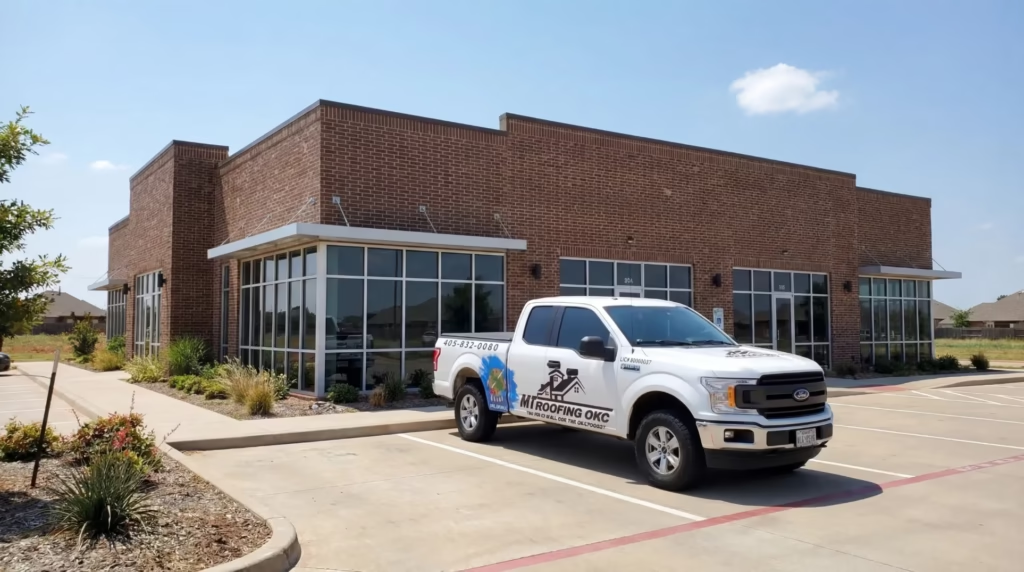
Not every commercial roof needs full replacement. Coatings can extend your roof’s life 10–20 years at a fraction of the cost, if the existing system is structurally sound. Contact us now!
5-10 years per coat
Acrylic Roof Coating
Most affordable coating option. Good reflectivity. Must have positive drainage.
Best for
Metal roofs and sloped surfaces
10-15 years per coat
Silicone Roof Coating
Waterproof even in ponding water. UV stable. Can be recoated indefinitely.
Best for
Existing BUR, metal, and mod bit roofs
20-30 years with recoating
Spray Polyurethane Foam (SPF)
Adds R-value insulation. Creates seamless, monolithic surface. Self-flashing.
Best for
Full reroofing without tear-off
How to Choose the Right Commercial Roof
Oklahoma Storm Exposure
OKC averages 3–4 significant hail events per year. Heat-welded seams (TPO, PVC) and standing seam metal handle our severe weather best. Factor in insurance premium impacts.
Budget: Upfront vs Lifecycle
EPDM and mod bit cost less upfront but have shorter lifespans. TPO balances cost and longevity. Standing seam metal costs more but can last 40–60+ years, often the lowest cost-per-year.
Building Type & Use
Restaurants need PVC (chemical resistance). Warehouses need value (TPO). Churches and retail need aesthetics (standing seam metal). Match the material to your building's specific demands.
Energy & Operating Costs
White reflective roofs (TPO, PVC, cool-coat metal) can reduce cooling costs 20–40%. For large commercial buildings, that's $0.30–$0.50/sq ft annually, thousands in savings.
Ownership Timeline
Planning to sell in 5 years? A coating may be smarter. Holding 20+ years? Invest in TPO or metal for the best long-term ROI.
Maintenance Access
Rooftop HVAC units, solar panels, or frequent foot traffic? Choose puncture-resistant options (60+ mil TPO/PVC) and plan for maintenance walkway pads.
Frequently Asked Questions
Can my commercial reroof in Oklahoma City qualify for a Section 179D tax deduction?
Yes, but act fast. Under the One Big Beautiful Bill Act (OBBBA), the Section 179D deduction is scheduled to sunset on June 30, 2026. Cool roofs (TPO, PVC, cool-coated metal) that reduce energy use by at least 25% can qualify for deductions up to $5.94 per square foot with PWA compliance. For a 50,000 sq ft building, that’s potentially $297,000 in tax deductions. Construction must begin before June 30; you don’t have to finish, just start. We partner with 179D certification specialists to help you qualify.
How often should I have my commercial roof inspected?
We recommend twice-yearly inspections, in spring (after winter storms and before severe weather season) and fall (before ice/freeze cycles). After any major hail event or severe storm, an immediate inspection is critical. Our AI-powered drone inspections cover 100% of the roof surface in a fraction of the time, using thermal imaging to detect trapped moisture invisible to the naked eye.
What is the best commercial roofing material for Oklahoma?
For most Oklahoma commercial buildings, TPO (60 mil minimum) offers the best balance of cost, energy efficiency, and storm performance. PVC is superior for restaurants and facilities with chemical exposure. Standing seam metal is the best long-term investment for buildings where aesthetics and 40+ year lifespan matter.
Does my commercial roof qualify for insurance coverage after hail?
Most commercial property insurance policies cover hail damage. Oklahoma’s severe weather means many commercial roofs have damage that qualifies for insurance-funded replacement. We handle the entire claims process, from the initial inspection through the Xactimate supplement, to maximize your coverage.
How long does a commercial roof last in Oklahoma?
It depends heavily on the material and maintenance: TPO (15–25 years), EPDM (20–30 years), PVC (20–30 years), Modified Bitumen (15–25 years), Standing Seam Metal (40–60+ years). Oklahoma’s hail, heat, and severe weather can shorten these lifespans if roofs aren’t properly maintained.
still unsure?
Talk to a Local Roofing Specialist Before You Decide.
Every business roofing is different. Get a free, no-pressure hail impact assessment from a local expert who’ll help you compare materials, costs, and insurance options side by side. Learn more about Oklahoma City from their official government website and Wikipedia page.
- Free Estimates
- Same-Day Response
- Insurance Experts